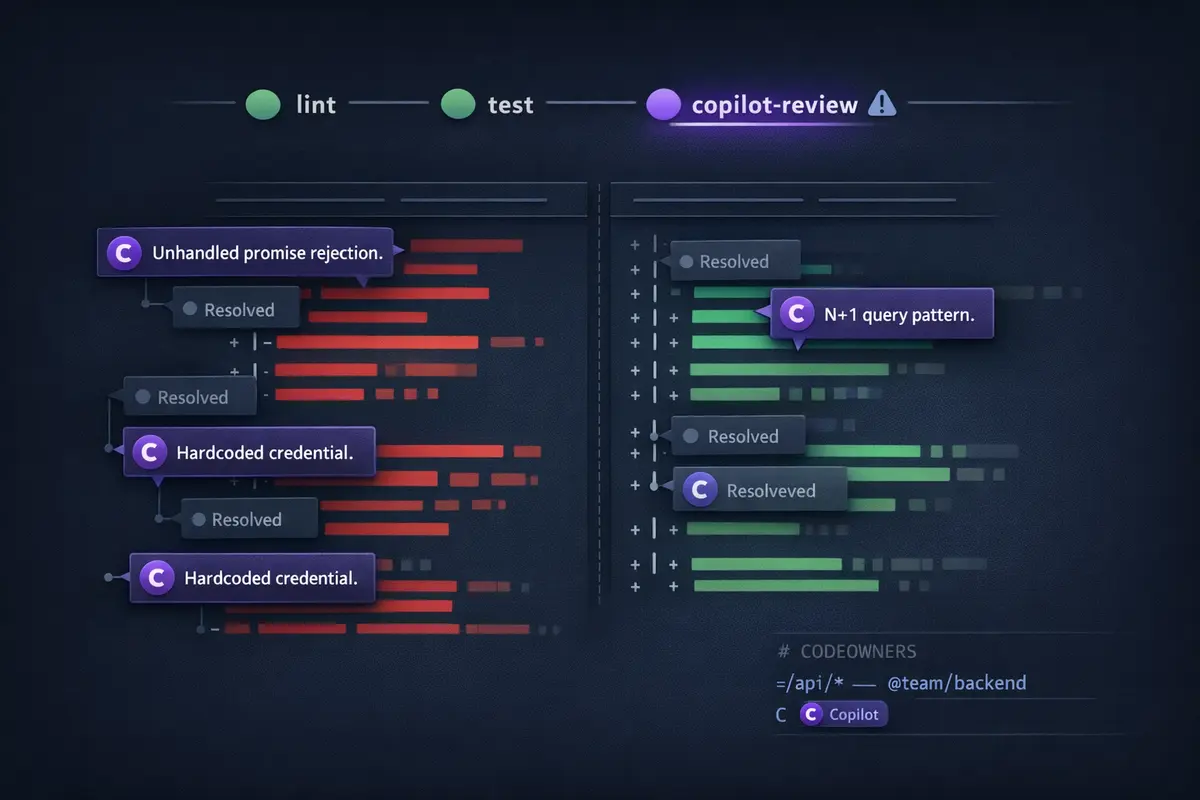
Most teams use GitHub Copilot the same way they use autocomplete: a single developer, in an editor, getting suggestions on the code in front of them. That's a real productivity gain. It's also a fraction of what Copilot can do in a CI context, where it can review every PR, on every push, without a human reviewer being available - and where the quality of its configuration determines whether it becomes a genuine signal or just another source of noise to dismiss.
This post covers how to wire up Copilot code review in a way that actually helps: what to configure, what to exclude, how to prevent it from becoming a gate that erodes trust, and how to read its output alongside human review rather than instead of it.
Wiring github/copilot-code-review in CI
The fastest way to operationalize Copilot review across every PR is the github/copilot-code-review action. It runs on PR events, analyzes the diff, and posts review comments directly on changed lines.
Start with a minimal workflow:
name: copilot-code-review

on:
  pull_request:
    types: [opened, synchronize, reopened, ready_for_review]

jobs:
  review:
    if: github.event.pull_request.draft == false
    runs-on: ubuntu-latest
    permissions:
      contents: read
      pull-requests: write
    steps:
      - uses: actions/checkout@v4
      - uses: github/copilot-code-review@v1
        with:
          github-token: ${{ secrets.GITHUB_TOKEN }}
Three behavior details matter for rollout:
It never approves PRs. Treat Copilot as a comment stream, not an approver. Required reviewer policies should still be human-only.
It reviews the diff, not your whole architecture. It catches local issues in changed code; it does not replace design review.
It should be tuned before broad rollout. Scope and instruction quality determine whether teams see signal or noise.
Enabling It: Org Policy vs. Repo Workflow
Copilot review still requires Copilot Business or Enterprise, but delivery happens in two layers:
- Organization or repository-level policy is the prerequisite that enables Copilot code review.
- Repository workflow controls when and how
github/copilot-code-reviewruns.
Org admins configure this in Settings → Copilot → Policies → Code review (or repository-level Copilot settings for per-repo control). If policy is disabled, the workflow will complete successfully in CI logs without posting any review comments on the PR.
This split is useful: platform admins enable the feature once, while each repo keeps execution details versioned, reviewable, and constrained to its own risk profile.
Configuring What Copilot Reviews
Out of the box, Copilot reviews everything in every diff. That is the wrong default for most real codebases. Machine-generated files, test fixtures, migration scripts, and vendored code will generate comments that nobody wants to read. Configuring scope before you roll this out to a team matters.
Path Filters
The action supports path_filters, so you can keep review focused on high-signal files:
- uses: github/copilot-code-review@v1
  with:
    github-token: ${{ secrets.GITHUB_TOKEN }}
    path_filters: |
      - 'src/**'
      - '.github/workflows/**'
This should be conservative by default: include only high-signal source and workflow paths first, then expand as needed. Revisit filters as your repo evolves so Copilot keeps looking where humans want help.
Custom Review Instructions
Custom instructions tell Copilot what to focus on, what to ignore, and what your team's standards are. They live in .github/copilot-instructions.md alongside a code-review section, or in a dedicated .github/copilot-review-instructions.md file. The repository-level settings UI also accepts them directly under Settings → Copilot → Custom instructions.
A well-structured instruction file makes the difference between generic comments ("this could throw") and comments that are specific to your codebase conventions:
# Code Review Instructions

## Focus Areas

Review all diffs for:
- Unhandled promise rejections and error paths that silently swallow exceptions
- Hardcoded credentials, secrets, or environment-specific values that belong in config
- Direct SQL string concatenation that should use parameterized queries
- Missing input validation on any function that accepts external data
- N+1 query patterns in ORM usage

## Ignore

Do not comment on:
- Code style or formatting (handled by our linter - see .eslintrc)
- Test coverage percentage or lack of test files in this PR
- TODO comments (we track these separately)
- Performance micro-optimizations unless there is a clear O(n²) or worse pattern

## Context

This is a Node.js API service. Database access uses Prisma. Authentication uses JWT
tokens validated by the `verifyToken` middleware. Any route handler that does not
call `verifyToken` should be flagged unless it is explicitly in the public routes list
at `src/routes/public.ts`.
The instruction file is committed to the repository, versioned, and reviewable in PRs like any other configuration. That is a feature - when the team decides to add a new focus area or update a convention, the change goes through a PR, gets discussed, and lands with a clear commit history.
Custom instructions have a length limit (currently around 8,000 characters). Prioritize security-relevant patterns and team-specific conventions over general best practices; Copilot already knows general best practices. The value of custom instructions is encoding the knowledge that is specific to your codebase.
Preventing Copilot from "Approving Itself"
Copilot review comments are advisory, but teams often run separate automation that auto-approves bot PRs (for dependency updates or chore changes). Add an explicit Copilot denylist there so Copilot-authored changes cannot be auto-approved by bot logic:
jobs:
  auto-approve-bot-prs:
    if: >
      github.event.pull_request.user.login != 'github-copilot[bot]' &&
      github.event.pull_request.user.login != 'copilot-swe-agent[bot]'
github-copilot[bot] is the review bot identity, and copilot-swe-agent[bot] is a common bot identity for Copilot-authored PRs created by coding agents. Excluding both prevents bot-written changes from being auto-approved by bot-only logic.
Pair that with branch protection requiring at least one human approval. The practical rule: Copilot can suggest and comment, but a human still owns merge intent.
The Advisory vs. Hard Gate Decision
This is the most consequential configuration choice, and most teams get it wrong by defaulting to the wrong answer.
The wrong answer: make Copilot review a required gate that blocks merges when it posts REQUEST_CHANGES.
Why it's wrong: Copilot will flag real issues and non-issues with similar confidence. It will comment on patterns that are intentional in your codebase because it lacks the context to know they're intentional. Developers will encounter legitimate PRs blocked by a Copilot comment they disagree with and no clear path to dismiss it without either fixing something that doesn't need fixing or granting themselves an exception that undermines the gate's purpose.
Once a required gate generates enough friction that developers start working around it - requesting each other's approvals before Copilot finishes, or dismissing reviews as a reflex - it is no longer a quality gate. It's a ceremony. The damage is not just to velocity; it's to the team's belief that automated tooling can be trusted, which makes the next time someone proposes a real quality gate harder.
The right answer: run Copilot review as a non-blocking, advisory-only check. Copilot posts its comments. Developers see them. Human reviewers see them. The PR can merge with outstanding Copilot comments - that is fine. The comments are signal, not mandates.
The way to enforce this configuration is to ensure that Copilot is never configured as a required reviewer in branch protection rules or rulesets, and that your repository's review requirements (e.g., "require 1 approving review from code owners") are satisfied by humans only.
To make this explicit in documentation your team can refer to, add it to your CODEOWNERS file as a comment:
# Copilot code review is enabled for all paths and runs automatically.
# Copilot review is ADVISORY ONLY - it does not count toward required reviewer approval.
# Do not dismiss Copilot comments without reading them, but do not feel obligated
# to address every comment before merging. Use judgment.

*       @your-org/eng-team
When Blocking Does Make Sense
There is a narrow category of Copilot comment that warrants a different policy: security findings. If Copilot flags a potential credential exposure, SQL injection pattern, or authentication bypass, that comment deserves mandatory review before merge - but the mechanism should be a human, not an automated block.
A pragmatic approach: configure a GitHub Actions workflow that is triggered when Copilot posts a review containing specific keywords. The workflow notifies a security channel (or opens an issue in a security repo) but does not block the PR. It creates a paper trail and a human gets eyes on it; the PR continues.
name: Copilot Security Alert Triage

on:
  pull_request_review:
    types: [submitted]

jobs:
  triage:
    if: >
      github.event.review.user.login == 'github-copilot[bot]' &&
      github.event.review.state == 'changes_requested'
    runs-on: ubuntu-latest
    permissions:
      issues: write
      pull-requests: read
    steps:
      - name: Check for security-related comments
        env:
          REVIEW_BODY: ${{ github.event.review.body }}
        run: |
          KEYWORDS="credential|injection|hardcoded|secret|auth bypass|XSS|CSRF"
          if echo "$REVIEW_BODY" | grep -qiE "$KEYWORDS"; then
            echo "security_flag=true" >> $GITHUB_OUTPUT
          fi
        id: check

      - name: Create security triage issue
        if: steps.check.outputs.security_flag == 'true'
        uses: actions/github-script@v7
        with:
          script: |
            await github.rest.issues.create({
              owner: context.repo.owner,
              repo: context.repo.repo,
              title: `[Security Triage] Copilot flagged PR #${context.payload.pull_request.number}`,
              body: `Copilot posted a REQUEST_CHANGES review on PR #${context.payload.pull_request.number} containing security-related keywords.\n\nPR: ${context.payload.pull_request.html_url}\nCopilot review: ${context.payload.review.html_url}\n\nA human should review this before or shortly after merge.`,
              labels: ['security', 'triage']
            })
This gets you the audit trail and the human escalation path without making Copilot a blocking gate. The PR author is not punished for a potential false positive; the security team is notified regardless.
Integrating with CODEOWNERS
CODEOWNERS and Copilot review are independent systems, but they interact in a way that's worth understanding. When a PR modifies files owned by @your-org/backend-team, those team members are auto-requested as reviewers - that is the CODEOWNERS mechanism. Copilot review runs in addition to that, not as a replacement for it.
The useful integration point is paths that have no CODEOWNERS entry. Files without an owner get no automatic human reviewer. Those are exactly the paths where Copilot review provides the most value - it is the only reviewer that will automatically comment on them.
Audit your CODEOWNERS file for gaps and make them explicit:
# Fully owned - humans review, Copilot supplements
src/api/**             @your-org/backend-team
src/web/**             @your-org/frontend-team

# Infrastructure - requires explicit DevOps review
.github/workflows/**   @your-org/devops
terraform/**           @your-org/devops

# No human owners - Copilot review is the primary automated check
# These should be promoted to owned paths when a team takes ownership
scripts/**
tools/**
docs/**
The comment is explicit that Copilot is providing the primary automated check for unowned paths. It is not invisible; it's a documented policy that the team can read and change. When someone takes ownership of scripts/**, the CODEOWNERS entry gets added and the comment gets updated - and the change goes through a PR.
Working with the Output at Scale
At small team sizes, Copilot review comments are visible in the normal PR review flow. At larger scales - dozens of active PRs across multiple repositories - a few patterns help keep the signal-to-noise ratio manageable.
Resolving vs. Dismissing
GitHub distinguishes between resolving a review comment (you addressed it) and dismissing a review (you are overriding it). For Copilot comments specifically:
- Resolve a comment when you fixed the issue Copilot flagged, even if you would have caught it anyway. This keeps the thread clean and signals to teammates that the concern was real.
- Dismiss or leave unresolved a comment when it's a false positive or a pattern that's intentional in your codebase. Leave a short reply explaining why - not for Copilot's benefit, but for the next human who reads the PR history and wonders why an apparently valid concern was not addressed.
The discipline of writing one sentence explaining a dismissal ("this is intentional - the retry logic is owned by the caller, not this function") pays for itself quickly in onboarding new developers who read PR histories to understand codebase conventions.
Tracking False Positive Patterns
When Copilot repeatedly flags a pattern that is intentional in your codebase, that is signal to update your custom instructions. A lightweight workflow: create a copilot-review-false-positives label in your repository. When a developer dismisses a Copilot comment as a false positive, they apply the label to the PR. At a monthly retro cadence, review the labeled PRs, identify recurring patterns, and add instructions to .github/copilot-review-instructions.md to suppress them.
This turns false positives from noise into signal about gaps in your instruction file - and the improvement compounds over time.
The Merge Pattern
The practical merge workflow for a team running Copilot review looks like this:
- Developer opens a PR. Copilot review runs automatically within a few minutes.
- Developer reads Copilot comments before requesting human review. If something is obviously wrong, they fix it and push - no need to involve a human reviewer for issues Copilot caught in seconds.
- Human reviewer is requested. They see a PR where the easy catches are already addressed; their review time goes toward design, context, and judgment.
- PR merges with or without residual Copilot comments, per the author's judgment. The security triage workflow runs if any comments triggered the keyword check.
The optimization in step 2 is the real productivity gain: Copilot is not replacing human review, it is preprocessing the PR so that human review is higher-signal. A reviewer who arrives at a PR where null checks and hardcoded values are already handled can spend their limited attention on the decisions that actually require a human.
What Copilot Review Doesn't Replace
To use this tool well, it helps to be clear-eyed about where it stops.
Copilot review does not catch architectural problems. A pattern that is locally valid but globally wrong - a service that correctly handles its own logic but violates a system-wide invariant - requires context that a diff reviewer cannot have. Architecture decisions belong in ADRs, reviewed before code is written, not discovered by automated review of the implementation.
Copilot review does not catch correctness for domain logic. Whether a billing calculation is correct, whether a state machine covers the right transitions, whether a data transformation produces the right output for edge cases in your specific domain - these require a reviewer who understands the domain. Copilot does not.
Copilot review does not replace pair programming or design review for complex changes. A PR that involves a significant new feature, a refactor, or a change to a shared contract benefits from synchronous discussion before the code is written, not asynchronous comments after.
The framing that works: Copilot review is good at catching the category of issues that a careful developer would catch by reading their own diff slowly. Most developers, under time pressure, do not read their own diffs that carefully before requesting review. Copilot does it for free, every time. That is a genuine and bounded value proposition - and it leaves the harder problems exactly where they should be.
AI implementation question? I'm here to help.