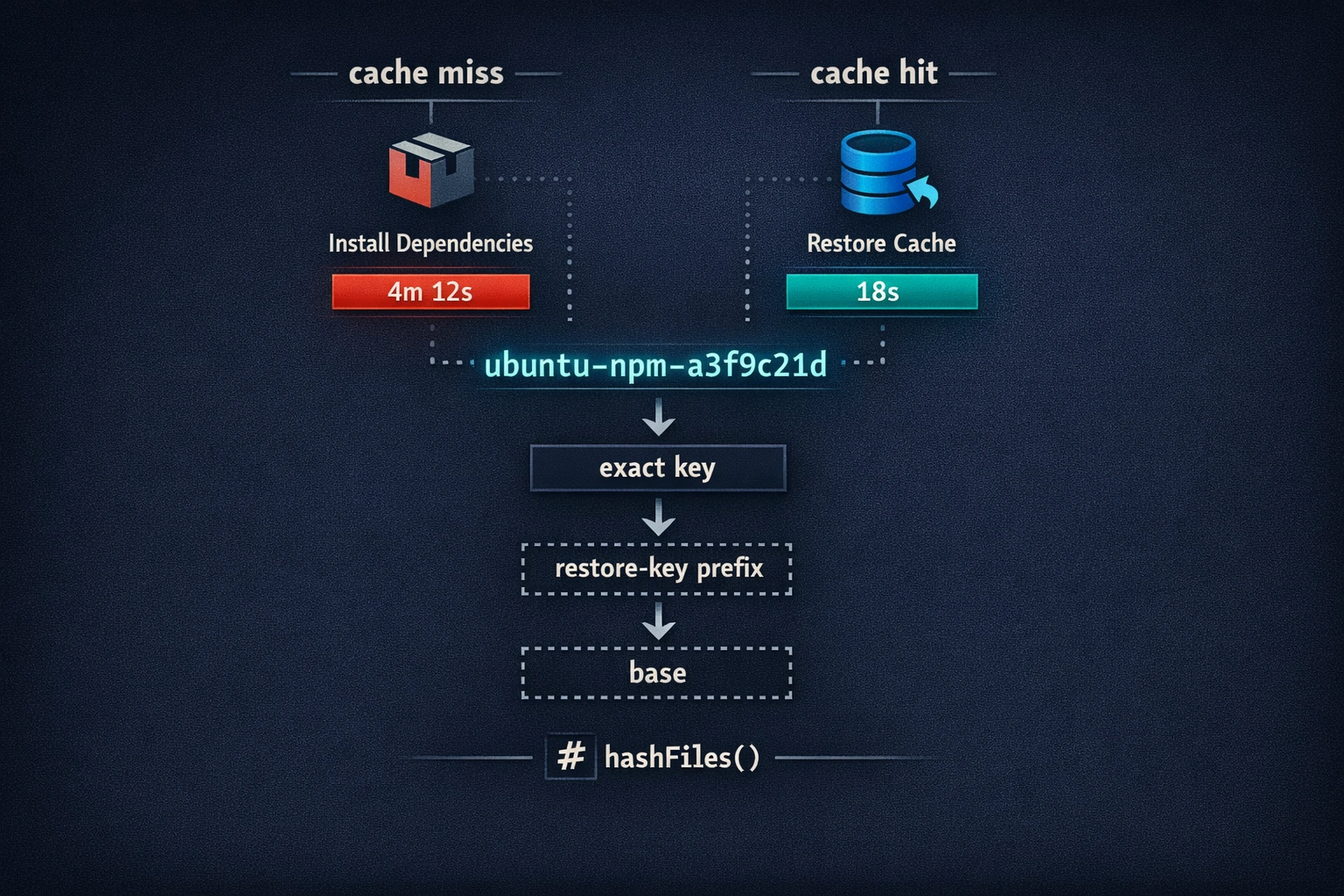
Your CI takes four minutes to install dependencies. With a well-designed cache, it takes eighteen seconds. The gap between those two numbers is almost never about network speed or disk I/O - it's about whether your cache key is written correctly.
actions/cache is deceptively simple to use and deceptively easy to use wrong. A key that's too broad invalidates on every run. A key that's too narrow never hits. Most teams land somewhere in the middle: a single key that hits inconsistently, a 30-40% hit rate they've stopped questioning, and CI minutes burning at the rate of a full install on every other push.
This post is the fix. Cache key anatomy, restore-keys fallback chains, branch scoping, matrix-aware keys, per-ecosystem examples, and the security model that keeps it all safe.
Why Most Caches Miss
The anti-pattern looks like this:
- uses: actions/cache@v4
  with:
    path: node_modules
    key: npm-cache
This key never changes. The first run writes the cache. Every subsequent run hits it - until someone changes a dependency, at which point the cached node_modules is stale and wrong. The solution most teams reach for is adding the lock file hash:
key: npm-${{ hashFiles('**/package-lock.json') }}
Better - but npm-a3f9c21d is the same key for an Ubuntu runner and a macOS runner, which means a cache written on one may be restored on the other. Compiled native modules, platform-specific binaries, and symlink layouts differ between operating systems. Cross-platform cache sharing silently corrupts builds.
The other failure mode is keys that are too broad - omitting the lock file hash entirely - or too narrow - including something like github.sha in the key. Committing the current SHA to the cache key guarantees a miss on every run except the one that wrote the cache. It turns actions/cache into an expensive no-op.
The actual hit rate problem is almost always one of these three things: missing the runner OS, missing the lock file hash, or including something that changes on every run. Fix those and hit rates climb above 80% without any other changes.
Cache Key Anatomy
A well-formed cache key has three components: runner OS, a stable identifier for the dependency set (usually a tool version), and a hash of the lock file. The canonical pattern for npm:
key: ${{ runner.os }}-npm-${{ hashFiles('**/package-lock.json') }}
This key:
- Changes when the OS changes.
runner.osreturnsLinux,Windows, ormacOS. An Ubuntu job and a macOS job have separate caches. - Changes when dependencies change.
hashFiles('**/package-lock.json')hashes everypackage-lock.jsonin the repo. Whennpm installupdates the lock file, the hash changes, the old cache key no longer matches, and the runner installs fresh. - Does not change between runs on the same OS with the same dependencies. A push to a feature branch with no dependency changes hits the same cache as the previous push to that branch.
hashFiles() accepts glob patterns. hashFiles('**/package-lock.json') covers monorepos with multiple lock files. For Gradle, hashFiles('**/*.gradle*', '**/gradle-wrapper.properties') captures both build scripts and the wrapper version. The function computes a SHA-256 over the sorted, concatenated contents of all matching files and returns the first 16 characters of the hex digest.
If you're caching a tool that also depends on its own version - actions/setup-node, actions/setup-python, and similar - include the version in the key:
key: ${{ runner.os }}-node-${{ matrix.node-version }}-${{ hashFiles('**/package-lock.json') }}
Two jobs running different Node versions install packages against different ABIs. Their caches should be separate.
Restore-Keys Fallback Chains
When no cache entry matches the primary key, actions/cache searches for a usable partial match using the restore-keys list, in order, treating each entry as a prefix. The first partial match it finds is restored - stale, but better than nothing for most dependency managers.
Here is a three-level chain for npm:
- uses: actions/cache@v4
  with:
    path: ~/.npm
    key: ${{ runner.os }}-npm-${{ hashFiles('**/package-lock.json') }}
    restore-keys: |
      ${{ runner.os }}-npm-
      ${{ runner.os }}-
Read this as a priority list:
- Exact key match - the current lock file hash. Full hit, nothing to install.
${{ runner.os }}-npm-prefix - a cache from a previous lock file state. Restores, thennpm installadds or removes the delta packages. Much faster than a cold install.${{ runner.os }}-prefix - any cache for this OS. Last resort, but any warmed npm cache beats downloading everything.
The reason stale caches are valuable: npm install against a partially-warm ~/.npm global cache still skips the network fetch for every package that hasn't changed. Only the diff needs downloading. For a project with 800 packages where two change, the difference between a cold install and a stale cache hit is the difference between downloading all 800 and downloading 2.
After the job completes, actions/cache writes a new cache entry for the exact key if one didn't already exist. The stale cache does not overwrite the one it was restored from - it creates a new entry. The exact-key entry is the authoritative one; the partial-match entries are fallbacks.
Branch Scoping
GitHub scopes cache access by repository and branch. A job running on a feature branch can read caches written from main, but a job on main cannot read caches written from a feature branch. Fork PRs are even more restricted: they cannot read caches from the parent repo at all. This is a deliberate security boundary.
The practical implication for cache key design: your default branch cache is the base that all feature branches fall back to. If you include github.ref in the primary key, each branch maintains an isolated cache that starts cold. If you omit github.ref, all branches share a single cache that overwrites each other on every push.
The right balance is to include github.ref in the primary key and exclude it from the restore-keys chain:
- uses: actions/cache@v4
  with:
    path: ~/.npm
    key: ${{ runner.os }}-npm-${{ github.ref_name }}-${{ hashFiles('**/package-lock.json') }}
    restore-keys: |
      ${{ runner.os }}-npm-${{ github.ref_name }}-
      ${{ runner.os }}-npm-refs/heads/main-
      ${{ runner.os }}-npm-
This gives you:
- Branch-scoped primary key - feature branches write their own caches and don't pollute the shared pool with every PR's lock file state.
- Fallback to
main's cache - a new branch's first run restores frommainrather than installing cold. - Last-resort fallback - any npm cache for this OS, in case
maindoesn't have a recent entry either.
The refs/heads/main- prefix in the fallback is explicit. github.ref_name returns main on the default branch, so the prefix matches that branch's cache entries.
For short-lived feature branches, branch-scoped caches are written once and usually read once. GitHub's LRU eviction takes care of them within a few days of the branch going idle. You don't need to clean up manually.
Matrix-Aware Cache Keys
Matrix builds that share a single cache key cross-contaminate. A job testing against Node 18 and a job testing against Node 20 should not share a cache - native addons, some packages, and occasionally .bin symlinks differ between Node versions.
The fix is to include the matrix variable in the key:
jobs:
  test:
    runs-on: ${{ matrix.os }}
    strategy:
      matrix:
        os: [ubuntu-latest, windows-latest]
        node-version: ['18.x', '20.x']
    steps:
      - uses: actions/checkout@v4

      - uses: actions/setup-node@v4
        with:
          node-version: ${{ matrix.node-version }}

      - uses: actions/cache@v4
        with:
          path: ~/.npm
          key: ${{ runner.os }}-node-${{ matrix.node-version }}-${{ hashFiles('**/package-lock.json') }}
          restore-keys: |
            ${{ runner.os }}-node-${{ matrix.node-version }}-
            ${{ runner.os }}-node-

      - run: npm ci
      - run: npm test
runner.os and matrix.os serve the same purpose here - the OS identifier. Using runner.os is slightly more reliable since it reflects the actual OS the runner is on, whereas matrix.os includes the latest suffix which can shift when GitHub updates the runner image. Either works; be consistent.
For a 2×2 matrix (2 OS × 2 Node versions), this produces four independent cache namespaces. Each one maintains its own history and its own fallback chain. Hits stay within the correct namespace; misses fall back to any cache for that OS/version pair, not to a different version's stale cache.
Per-Ecosystem Examples
npm
Cache ~/.npm (the global npm content-addressable cache), not node_modules. npm ci populates node_modules from ~/.npm - if the global cache is warm, npm ci takes seconds even when node_modules is cold. Caching node_modules directly is fragile: it ties the cache to the local directory structure, breaks cross-version fallbacks, and can cause subtle issues when native modules are involved.
- uses: actions/cache@v4
  with:
    path: ~/.npm
    key: ${{ runner.os }}-npm-${{ hashFiles('**/package-lock.json') }}
    restore-keys: |
      ${{ runner.os }}-npm-

- run: npm ci
Gradle
Gradle's cache lives in ~/.gradle/caches and ~/.gradle/wrapper. Hash both build scripts and the wrapper properties file - either can change between builds:
- uses: actions/cache@v4
  with:
    path: |
      ~/.gradle/caches
      ~/.gradle/wrapper
    key: ${{ runner.os }}-gradle-${{ hashFiles('**/*.gradle*', '**/gradle-wrapper.properties') }}
    restore-keys: |
      ${{ runner.os }}-gradle-

- run: ./gradlew build
The **/*.gradle* pattern matches build.gradle, build.gradle.kts, settings.gradle, and settings.gradle.kts. If your build scripts are stable but your dependency versions in a libs.versions.toml file change frequently, include that file in the hash as well.
pip
Cache ~/.cache/pip. Include the Python version in the key - wheels are version and platform-specific:
- uses: actions/setup-python@v5
  with:
    python-version: '3.12'

- uses: actions/cache@v4
  with:
    path: ~/.cache/pip
    key: ${{ runner.os }}-pip-${{ hashFiles('**/requirements*.txt') }}
    restore-keys: |
      ${{ runner.os }}-pip-

- run: pip install -r requirements.txt
hashFiles('**/requirements*.txt') matches requirements.txt, requirements-dev.txt, requirements-test.txt, and any other variant. If you use pyproject.toml for dependencies, substitute hashFiles('**/pyproject.toml').
If you use actions/setup-python@v5 with the cache parameter, it handles this automatically. The built-in caching in setup actions is equivalent to the manual pattern above - use whichever you prefer, but don't do both.
Docker Layer Caching
Docker layer caching in GitHub Actions uses docker/build-push-action with the cache-from and cache-to parameters and the type=gha cache backend, which writes directly to the GitHub Actions cache API:
- uses: docker/setup-buildx-action@v3

- uses: docker/build-push-action@v5
  with:
    context: .
    push: true
    tags: ghcr.io/${{ github.repository }}:${{ github.sha }}
    cache-from: type=gha
    cache-to: type=gha,mode=max
mode=max caches all layers, including intermediate build stages. mode=min (the default) caches only the final stage. For multi-stage Dockerfiles where the build stage is expensive - compiling a large Go or Rust binary, for example - mode=max is worth the additional cache storage.
The type=gha backend respects the same cache scoping rules as actions/cache. A push to a feature branch can restore layers cached from main, but writes from the feature branch don't pollute the main cache. This means your CI's Docker builds get free warm-layer fallback on every branch without any additional configuration.
Cache Poisoning and GitHub's Isolation Model
Cache poisoning is the scenario where a malicious cache entry is written by an untrusted source and then read by a trusted workflow, causing it to execute or deploy compromised artifacts.
GitHub's isolation model addresses this structurally:
- Caches are scoped to a repository and branch. A cache written by a workflow run in
repo-Ais never readable byrepo-B. - Fork PRs cannot read the parent repository's cache. A
pull_requestevent from a fork runs in the fork's security context. TheACTIONS_CACHE_URLtoken issued to that runner is scoped to the fork - it has no read access to the parent repo's cache entries. This blocks the attack where a malicious PR poisons the parent's cache and waits for a privileged workflow to restore it. - Cache entries are immutable once written. A key that already has an entry cannot be overwritten by another run. The first writer wins. This prevents a race where an attacker writes a poisoned entry by racing the legitimate workflow.
The practical implication: if your workflows run on pull_request events from forks (common for open source projects), the isolation model already protects you. Fork PR workflows cannot read or write your repo's caches. You do not need to add logic to skip caching on fork PRs.
The residual risk is internal: a workflow triggered from a branch in your own repo by a contributor with push access could write a malicious cache. This is a trust-level issue, not a caching issue - if a contributor has push access, they can already modify workflow files, which is a far larger attack surface than cache entries.
One concrete hardening step: use actions/cache/restore and actions/cache/save as separate steps rather than the combined actions/cache. This lets you restore before the main work and save after it, and it gives you explicit control over when and whether saving happens. In particular, you can skip the save step if the primary key already had a hit:
- uses: actions/cache/restore@v4
  id: cache-restore
  with:
    path: ~/.npm
    key: ${{ runner.os }}-npm-${{ hashFiles('**/package-lock.json') }}
    restore-keys: |
      ${{ runner.os }}-npm-

- run: npm ci

- uses: actions/cache/save@v4
  if: steps.cache-restore.outputs.cache-hit != 'true'
  with:
    path: ~/.npm
    key: ${{ runner.os }}-npm-${{ hashFiles('**/package-lock.json') }}
The if condition prevents redundant saves when the primary key already matched. It's a minor optimization - actions/cache already avoids overwriting an existing key - but the split step pattern is valuable for a different reason: the save step runs even if the main job fails. The combined actions/cache action's post-step also runs on failure, but having explicit control makes the behavior readable rather than implicit.
Cache Size Limits and Eviction
GitHub enforces a 10 GB total cache limit per repository. When the total size exceeds 10 GB, the oldest entries are evicted until the repo is back under the limit. There is no per-entry size limit - a single large cache entry is valid, it just consumes the shared budget.
The practical limit this creates: don't cache build output. Build artifacts, compiled binaries, and test reports are not dependency caches - they change on every commit, they consume space fast, and restoring a stale build artifact is almost never useful. Cache only the inputs that don't change on every run: downloaded packages, resolved dependency trees, compiler toolchains.
A few rules that keep cache storage under control:
Cache the global package manager cache, not the local install directory. For npm, ~/.npm not node_modules. For pip, ~/.cache/pip not venv/. The global cache stores compressed tarballs; the local install directory stores unpacked files which are larger and more volatile.
Include enough specificity in the key that stale entries expire quickly. A key with a lock file hash creates a new entry every time dependencies change. If you change dependencies frequently, old entries accumulate. They'll be evicted by LRU, but if you're near the 10 GB limit, you can add an explicit cache version prefix to force a clean sweep:
key: v2-${{ runner.os }}-npm-${{ hashFiles('**/package-lock.json') }}
Increment v2 to v3 to immediately stop using any previously written v2 entries.
Use actions/cache/save with if: always() for jobs that run long test suites. By default, the save step only runs if the main job succeeded. For long-running jobs where you want to preserve the partially-warm state even on failure, use the split step pattern with if: always() on the save step.
Closing
The cache key is three things: runner OS, tool version or ecosystem identifier, and lock file hash. The restore-keys chain is how you trade exactness for hit rate - a stale cache that installs a 50-package delta is faster than a cold install every time. Branch scoping keeps feature caches from polluting main, and the fallback to main means new branches don't start cold. Matrix builds need one cache namespace per combination - omit the matrix variable and you're sharing state across jobs that shouldn't share it.
This is five minutes of work per workflow. The return is measured in CI minutes per week, compounded across every developer on every push. Most teams treat cache key design as an afterthought, which is why most teams have 30% hit rates when they could have 90%.
Write the key correctly. Add the fallback chain. Scope it to the branch. That's the whole thing.
Questions or corrections? Reach out.