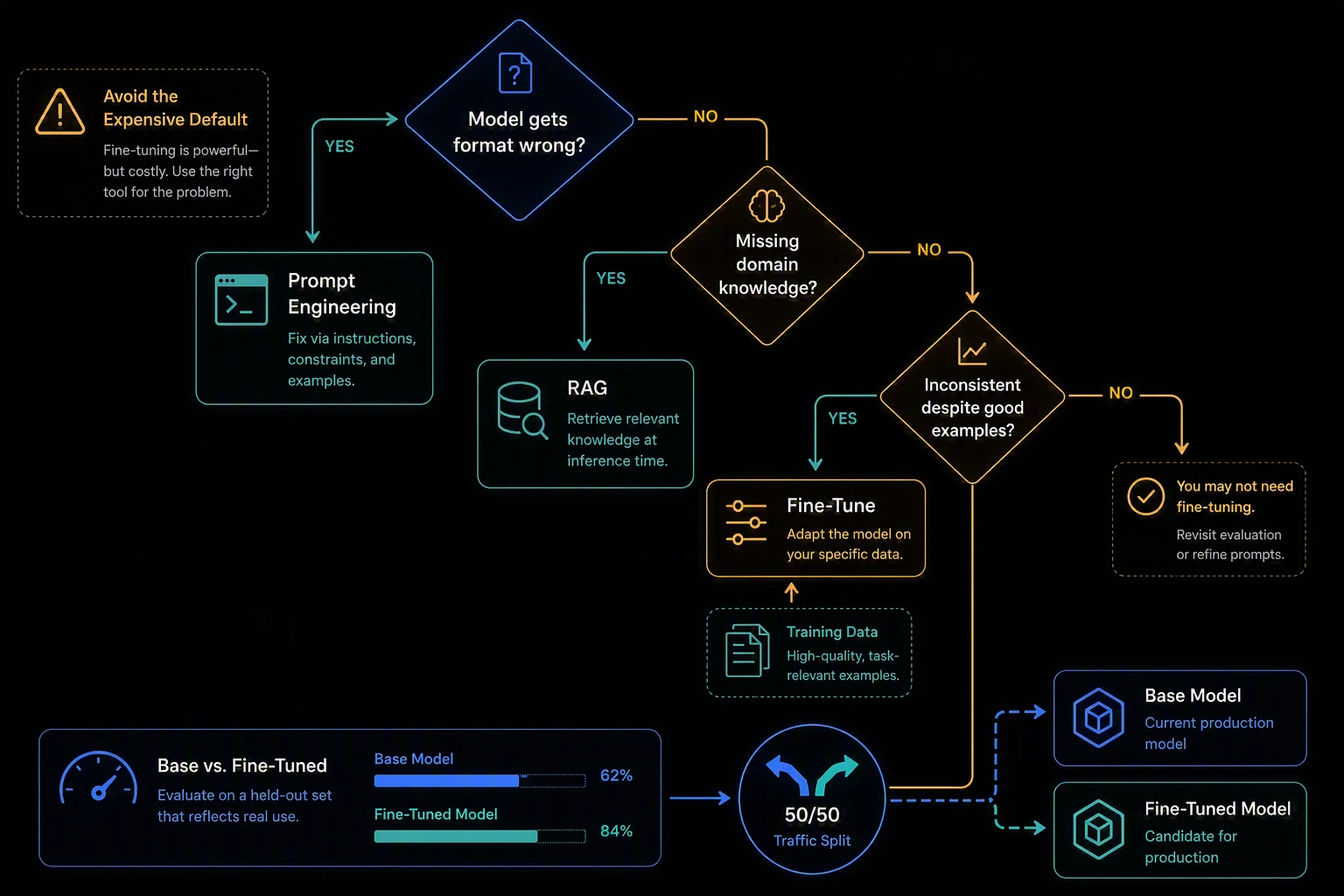
Fine-tuning has a gravitational pull that's out of proportion to how often it's the right call. It sounds like the "serious" option - training your own model, not just writing a better prompt - so it gets reached for whenever prompting starts to feel unreliable, before anyone's actually diagnosed why it's unreliable. That diagnosis matters because fine-tuning is the most expensive and least flexible of the three real options, and two of the three failure modes it gets blamed for aren't fixed by it at all.
The Decision Framework: What's Actually Failing
Three distinct problems get lumped together as "the model isn't working well enough," and each has a different fix:
The model doesn't know the domain-specific facts. It's confidently wrong about your product's pricing tiers, your internal terminology, or last week's incident postmortem - because that information was never in its training data and isn't in the prompt either. This is a retrieval problem. The RAG-in-production post is the fix: ground the model in the actual source documents at query time. Fine-tuning doesn't teach a model new facts reliably - it teaches it patterns, and a fact baked into fine-tuning weights is exactly as stale six months from now as a fact baked into a prompt.
The model has the knowledge but gets the format, tone, or structure inconsistent. Given the right context, it produces a correct answer sometimes formatted as prose, sometimes as a bulleted list, sometimes with the wrong level of formality - and few-shot examples in the prompt narrow this down but don't fully close it. The prompt engineering post covers the first line of defense here, and it resolves most cases. When it doesn't - when you've iterated on the prompt and few-shot examples and the format is still inconsistent across a large enough sample to matter - that residual inconsistency is what fine-tuning is actually good at collapsing.
The model needs to reliably do something narrow, high-volume, and repetitive, where the cost of a large prompt with extensive few-shot examples on every single call adds up - both in latency and in token cost at scale. Fine-tuning bakes the pattern into the weights once, so production calls run with a short prompt instead of a long one carrying five or six examples every time.
The framework, as a single test before starting any fine-tuning work: have you actually tried better prompting and RAG first, and does the failure survive both? If the answer is no, you haven't earned the cost of fine-tuning yet - you've just found a prompt that needs another iteration or a retrieval gap that needs closing.
Preparing a Training Dataset
Azure AI Foundry's supervised fine-tuning expects the same chat-completion message format your application already sends the model, as JSONL - one training example per line:
{"messages": [{"role": "system", "content": "You triage support tickets into a priority and category."}, {"role": "user", "content": "Customer says checkout is throwing a 500 error on the payment step, happening to multiple users since this morning."}, {"role": "assistant", "content": "{\"priority\": \"P1\", \"category\": \"payments\", \"reasoning\": \"Multi-user impact on a revenue-critical path, recent onset suggests a regression.\"}"}]}
{"messages": [{"role": "system", "content": "You triage support tickets into a priority and category."}, {"role": "user", "content": "User asking how to change their display name in account settings."}, {"role": "assistant", "content": "{\"priority\": \"P4\", \"category\": \"account-settings\", \"reasoning\": \"Self-service question, no functional impact, documentation would resolve it.\"}"}]}
The quality bar that actually matters here: every example should be one you'd be comfortable citing as "the correct answer" if a teammate asked why the model behaved a certain way - inconsistent or borderline-correct examples in the training set don't average out into a better model, they teach it the same inconsistency the fine-tune is supposed to remove. A few hundred carefully reviewed examples that agree with each other beats a few thousand scraped from unreviewed production logs.
Running the Fine-Tune Job
from azure.ai.projects import AIProjectClient
from azure.identity import DefaultAzureCredential

project_client = AIProjectClient(
    endpoint="https://your-foundry-resource.services.ai.azure.com/api/projects/your-project",
    credential=DefaultAzureCredential(),
)

fine_tune_job = project_client.fine_tuning.jobs.create(
    training_file="ticket-triage-train.jsonl",
    validation_file="ticket-triage-validation.jsonl",
    model="gpt-4o-mini-2024-07-18",
    hyperparameters={
        "n_epochs": 3,
    },
    suffix="ticket-triage-v1",
)

print(f"Job ID: {fine_tune_job.id}, status: {fine_tune_job.status}")
The validation file matters more than it looks like it should: it's what catches overfitting - a model that's memorized the training examples rather than generalized the pattern - before you find out in production. n_epochs is the main lever for that tradeoff; too few and the model hasn't learned the pattern, too many and it starts reproducing training examples' quirks rather than the underlying rule they were meant to teach.
Evaluating the Fine-Tuned Model Against the Base
The same discipline the LLM evaluation post established - score against a held-out test set, not a vibe check - applies directly here, with one addition: run the base model and the fine-tuned model against the identical test set and compare, since "the fine-tuned model scores 0.89" means nothing without knowing what the base model scored on the same questions.
from azure.ai.evaluation import evaluate

def target_base(ticket_text: str) -> dict:
    response = base_model_client.chat.completions.create(
        model="gpt-4o-mini",
        messages=[{"role": "system", "content": TRIAGE_SYSTEM_PROMPT}, {"role": "user", "content": ticket_text}],
    )
    return {"response": response.choices[0].message.content}

def target_fine_tuned(ticket_text: str) -> dict:
    response = base_model_client.chat.completions.create(
        model="gpt-4o-mini-2024-07-18.ft-ticket-triage-v1",
        messages=[{"role": "system", "content": "You triage support tickets into a priority and category."}, {"role": "user", "content": ticket_text}],
    )
    return {"response": response.choices[0].message.content}

for name, target in [("base", target_base), ("fine-tuned", target_fine_tuned)]:
    results = evaluate(
        data="ticket-triage-eval-set.jsonl",
        target=target,
        evaluators={"correctness": TriageCorrectnessEvaluator()},
        output_path=f"eval-results-{name}.json",
    )
    print(f"{name}: {results.metrics}")
If the fine-tuned model doesn't clear the base model by a margin that justifies the added deployment complexity and per-model hosting cost, the honest conclusion is that the underlying problem was solvable with a better prompt, and fine-tuning added cost without adding accuracy - a real, not-uncommon outcome, not a failed experiment.
Deploying Behind an A/B Traffic Split
Given a fine-tuned model does test out ahead of the base, deploy it as an addition, not a swap - the same gradual-rollout discipline the LLMOps prompt-versioning post applied to prompt versions applies to model versions:
import hashlib

def select_model(request_id: str, fine_tuned_percentage: int) -> str:
    bucket = int(hashlib.sha256(request_id.encode()).hexdigest(), 16) % 100
    return "gpt-4o-mini-2024-07-18.ft-ticket-triage-v1" if bucket < fine_tuned_percentage else "gpt-4o-mini"
Running both models side by side against live traffic - not just the held-out eval set - surfaces the gap between "scores well on curated examples" and "holds up on the actual messy distribution of real tickets," and a fine-tuned model that regresses in production is a config change back to 0%, not a redeploy.
Closing
The decision framework is worth internalizing precisely because fine-tuning's appeal is emotional as much as technical - it feels like the sophisticated option, so it gets tried first instead of last. It should be tried last: after a genuinely iterated prompt, after a retrieval gap has been ruled out, for the specific residual problem those two don't fix - narrow, high-volume, format-consistency work where the cost of a large per-call prompt is real and a smaller, more consistent model earns back that cost. Reached for in that order, fine-tuning is a precise tool. Reached for first, it's an expensive way to discover the problem was somewhere else.
Questions or corrections? Reach out.